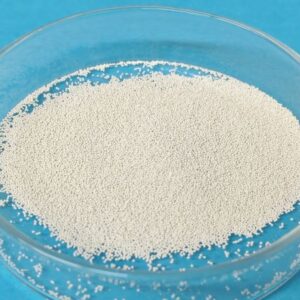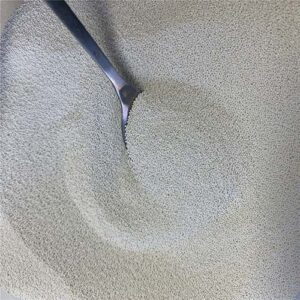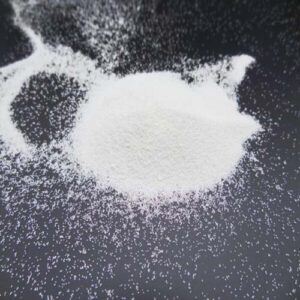
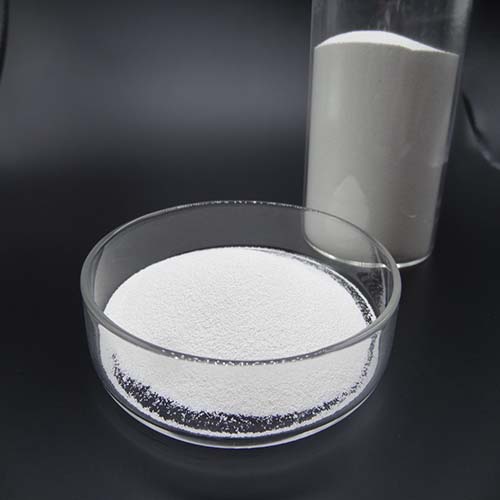
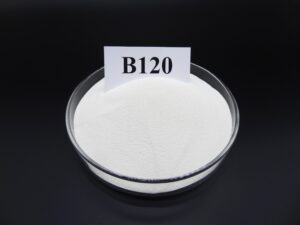
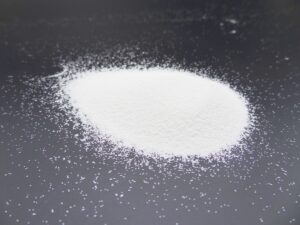
zirconia ceramic beads B120 (63–125 µm) for blasting porcelain tiles
Zirconia Ceramic Beads B120 represent a premium solution for surface treatment of porcelain tiles. Engineered with precision and manufactured from high-performance zirconium dioxide (ZrO₂), these spherical beads are specifically designed to meet the demanding requirements of the ceramic tile industry. With a controlled particle size distribution of 63 to 125 microns, the B120 grade delivers consistent, repeatable results for both decorative and functional blasting applications.
PHYSICAL PROPERTIES-zirconia ceramic beads B120 (63–125 µm) for blasting porcelain tiles
| Specific Weight | 4.30g/cm3 |
| Mohs Hardness | 7.0 |
| Vickers/Rockwell hardness | 700HV/60HRC |
| Bulk density | 125um and above: 2.30g/cm3, 125um and below: 2.1-2.2g/cm3 |
TYPICAL CHEMICAL ANALISIS [%]-zirconia ceramic beads B120 (63–125 µm) for blasting porcelain tiles
| Component | Typical value (%) | Conventional value (%) |
| ZrO2 | 63.80 | 60-70 |
| SiO2 | 26.82 | 28-33 |
| AL2O3 | 9.08 | Max 10 |
| Fe2O3 | 0.03 | Max 0.1 |
| TiO2 | 0.24 | Max 0.4% |
Optimal Particle Size for Porcelain Tiles
The B120 bead size falls within the fine-to-medium range, making it ideal for processing porcelain tiles. Unlike coarser abrasives that may cause surface pitting or structural damage, the 63–125 µm beads provide a controlled etch that enhances surface uniformity. This particle range effectively removes thin glazing layers, production residues, or minor surface contaminants without compromising the tile’s flatness or dimensional integrity. The result is a satin-matte, evenly textured surface ready for further treatment.
High-Purity Zirconia Composition
Unlike conventional blasting media such as silica sand, glass beads, or brown aluminum oxide, zirconia ceramic beads offer superior hardness (approx. 700–800 HV) combined with excellent fracture toughness. The high-purity ZrO₂ matrix ensures that the beads do not fragment easily upon impact, significantly reducing dust generation and media consumption. For porcelain tile manufacturers, this translates into cleaner working environments, lower equipment wear, and reduced operational downtime for media refill.
Spherical Shape for Gentle Yet Effective Blasting
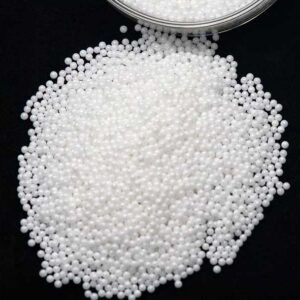
Each bead is manufactured to be truly spherical, with roundness exceeding 90%. The spherical morphology delivers a peening-type action rather than a cutting or gouging effect. When directed at a porcelain tile surface, the beads create a fine, isotropic dimple pattern without introducing micro-cracks, sharp stress risers, or surface debris. This is particularly important for glazed porcelain tiles where maintaining surface strength and avoiding visual defects is essential. The blasted surface shows a uniform matte finish with no directional scratches or uneven zones.
Improving Coating and Adhesion Performance
Porcelain tiles are often subsequently coated with sealants, anti-slip layers, digital inks, or bonding agents. A properly blasted surface using B120 beads significantly improves mechanical interlocking between the tile substrate and any applied coating. The micro-roughness created by the beads typically ranges from Ra 0.6 to 1.2 µm, which is optimal for enhancing adhesion without reducing the tile’s cleanability or stain resistance. For back-tile surfaces intended for mortar or adhesive bonding, blasting with zirconia beads dramatically increases pull-off strength.
Long Service Life and Cost Efficiency
Thanks to the high fracture resistance of zirconia, B120 beads can be recycled multiple times in closed-loop blast systems. Compared to glass beads which rapidly lose their cutting efficiency, or alumina which fractures into sharp sub-particles, zirconia ceramic beads maintain their spherical shape and size distribution over many cycles. This reduces the cost per square meter of tile processed, making B120 an economically sound choice for high-volume production lines.
Model Specifications
| Model | Particle size range |
| B20 | 600-850 um |
| B30 | 425-600 um |
| B40 | 250-425 um |
| B60 | 125-250 um |
| B80 | 180-250 um |
| B100 | 125-180 um |
| B120 | 63-125 um |
| B125 | 0-125 um |
| B170 | 45-90 um |
| B205 | 0-63 um |
| B400 | 30-63 um |
| B500 | 10-30 um |